
On most fishing charters in Mauritius, the fish you catch belong to the boat, not to you. That is the long-standing local convention, not a trick, and most crews will still give you a fish or a share of the catch for dinner and fillet it on the way in. Billfish such as marlin are a separate case: many boats release them, and the rest keep them for the boat. The only way to know which arrangement you have is to agree it before you sail.
Tipping the crew is the other question guests are unsure about. In Mauritius it is optional, not expected as a fixed share of the price, and a tip in cash at the end of a good day is appreciated. More on both below.
The short answer
The catch belongs to the boat unless you have agreed otherwise. What guests usually get is a fish or a portion for their own table, cleaned and filleted. What guests usually do not get is the whole catch, and on almost no boat do they get a marlin to take away.
None of this is written into your booking by default. It is a conversation, and it goes much better before the trip than on the dock with a cool box full of wahoo in front of you.
Why the fish belongs to the boat
Visitors from the UK or Spain sometimes read this as the crew taking something that is theirs. It helps to understand where the convention comes from.
Big game fishing in Mauritius grew up as a working fishery that also took guests. On many boats the catch is sold locally, to markets, restaurants and hotels, and that has always been part of how a day at sea pays for its fuel and its crew. The trip you book covers the boat, the skipper, the crew, the tackle and the bait. It is not a purchase of whatever comes over the side.
The same convention runs across much of the Indian Ocean and a lot of tropical big game fishing generally. Operators on the island say so plainly on their own sites, and the large booking platforms mention it in a line. What none of them explain is what the options actually are, so here they are.
What you can usually take home
Practice varies from boat to boat, and all of the following are normal in Mauritius as of September 2026.
| Arrangement | What it means for you | What to ask |
|---|---|---|
| Boat keeps the catch | You fish, the crew keeps everything | Is any of it offered to guests? |
| Boat keeps, guests get a share | The most common deal: a fish or a set amount for your table | How much, and is it filleted? |
| Catch is split | Guests and crew divide the catch on the dock | Split how, and who chooses? |
| Guests keep the catch | Rare, and usually a private arrangement | Is this written on the booking? |
| Catch and release | Fish, often billfish or GT, go back alive | Which species does this cover? |
The share for guests is usually framed in fish or in weight rather than as a fraction of the day’s catch, which is fair on a day when the boat hooks one wahoo and fair on a day when it fills the box. If you are a family on a half day trip, a single good fish is more than you can eat in one sitting anyway.
Marlin and other billfish
Blue marlin is the fish Mauritius is famous for, and it is the one where expectations go most wrong.
We could find no blanket national rule that requires every marlin caught on a Mauritius charter to be released, as of September 2026. What exists instead is operator policy. Many boats now release all billfish, and some take part in tagging programmes that follow where the fish go after release. Other boats keep marlin, and when they do, the fish stays with the boat. You will not be carrying a marlin back to your hotel.
The island’s best known competition, the South Indian Ocean Billfish Competition run by the Le Morne Anglers’ Club at Black River, is built around release. It is usually held in late January, near the peak of the marlin season. If you care about the fish going back, choose a boat whose release policy says so, and ask before you book rather than in the fighting chair.
For when marlin are realistic at all, see the best fishing seasons in Mauritius.
What tends to happen, species by species
What you are likely to be offered depends a great deal on what you catch.
| Species | Usually | Why |
|---|---|---|
| Wahoo | Shared with guests | Excellent eating and easy to fillet |
| Yellowfin tuna | Shared, or kept by the boat | Good eating, and a big one is far more than a table needs |
| Dorado | Shared with guests | Good eating, often caught in numbers |
| Reef fish on a bottom fishing trip | Often shared, especially with families | Smaller fish, easy to cook the same evening |
| Giant trevally | Released | GT fishing culture is almost entirely catch and release |
| Blue marlin | Released or kept by the boat | Operator policy, see above |
The pattern is simple enough. The fish that end up on guests’ plates are the ones caught trolling beyond the reef and the ones from a relaxed morning of bottom fishing inside the lagoon. The trophy species are the ones least likely to leave the boat with you.
So if fish for dinner matters, pick the trip type to match: a light tackle small game trip in the southeast lagoon out of Mahebourg mixes casting, light trolling and bottom fishing, while a full day of big game fishing from Grand Baie is about the fight more than the fillets. A GT popping day from Mahebourg is a release trip by nature.
Do you need a licence?
Not on a licensed charter. The boat operator holds the licences needed to take paying guests fishing, so you do not buy a personal permit for a charter trip.
It is different if you plan to fish on your own, from the shore or from a private boat. Mauritius regulates recreational fishing under the Fisheries Act 2023, which replaced the Fisheries and Marine Resources Act 2007, and the Ministry responsible for fisheries and the blue economy is the body to check with. Rules on lagoons, protected areas and gear change, so confirm with the Ministry before fishing independently rather than relying on anything older than your trip.
Getting your fish cooked
A fish in a cool box is only half the plan. Settle where it is going to be cooked before you leave the dock.
- Ask the crew to clean and fillet it. Most will as a matter of course. Ask for it bagged and on ice if you have a transfer to sit through.
- A villa or self catering apartment is the easy case: you have a kitchen.
- A hotel restaurant may cook it for you, or may not. Some kitchens are happy to, others will not take in fish they did not buy for food hygiene reasons. Ask the hotel the day before, not on arrival with a dripping bag.
- Some trips include a barbecue of the morning’s catch. If that is what you want, pick a trip that offers it rather than hoping.
Taking fish home on the plane
Possible in principle, and more trouble than most people expect. Your home country sets the rules, not Mauritius, and it may limit how much fish you can bring back in personal luggage and in what form. Check your own government’s guidance on personal food imports before you fly, including gov.uk for the UK and the equivalent in your EU country, then check your airline’s rules on frozen food in the hold.
For most visitors, eating the fish on the island is the better answer.
Do you tip the crew on a Mauritius fishing charter?
You do not have to, and a tip is welcome when the day went well. Mauritius has no fixed tipping custom of the kind American visitors are used to. Travel guidance for the island, including the CIA World Factbook’s travel facts sheet and local destination companies, describes tips for guides and drivers as optional and appreciated rather than owed. A charter crew is no different.
What changes the picture on a fishing boat is how hard the crew works for you. On a typical trip the mate rigs and sets the lines, watches the spread, clears the cockpit when a fish strikes, coaches a first timer through the fight, gaffs or releases the fish and then cleans and fillets your share on the way in. On a day like that, a tip is a natural thank you. On a day when the sea was flat in every sense, nobody on a Mauritius boat will hold it against you if you simply shake hands.
How to do it
- Cash, at the dock. Small boat operators prefer cash, and a tip paid in advance thanks nobody for anything. Bring a little local cash on the day.
- Give it to the captain for the whole crew, or to the mate directly if the skipper owns the boat. Either is normal; if you are not sure, ask the captain how they prefer it.
- One tip for the group is the usual way when friends or a family share a private boat. You do not each need to tip separately.
- Do not let the catch decide alone. A crew that worked hard on a slow day has earned as much as one that got lucky.
Other ways to say thanks
For a small boat, a good word online often matters as much as cash. After a trip booked on Reelzy you can leave a review on the listing, and a written review is what the next guest reads before choosing that boat. Photos of your catch help too: captains post catch reports on Reelzy, and a fish you were proud of makes a better one than a stock picture.
Tipping and the catch are linked in one quiet way. If the crew gave you a generous share of fish, cleaned and bagged on ice, that is part of the service you are thanking them for. If the boat kept the catch as agreed, that is the normal deal and not a reason to skip the thanks.
Before you book
- Ask what happens to the catch, in writing, in the booking conversation. “Boat keeps it, guests get a fish for dinner” is a perfectly good answer. You just want to know it.
- Ask the billfish policy if marlin is the reason you are going. Release, tag, or keep.
- Ask whether they will fillet and ice your share, and whether that happens on the boat or at the dock.
- Sort the kitchen at your hotel or villa before the trip, not after it.
- Book near where you are staying. Fresh fish and a long taxi ride do not mix.
- Bring some cash on the day if you want to thank the crew. Optional, and easiest handed over at the dock.
Ready to go?
Most of the boats on Reelzy work the northwest coast, and Trou aux Biches has the largest cluster on the island, with Grand Baie a few minutes up the coast. Every listing lets you message the captain directly, which is exactly where the catch question belongs. Browse all fishing charters in Mauritius, pick the boat that fits your trip, and ask them before you book.
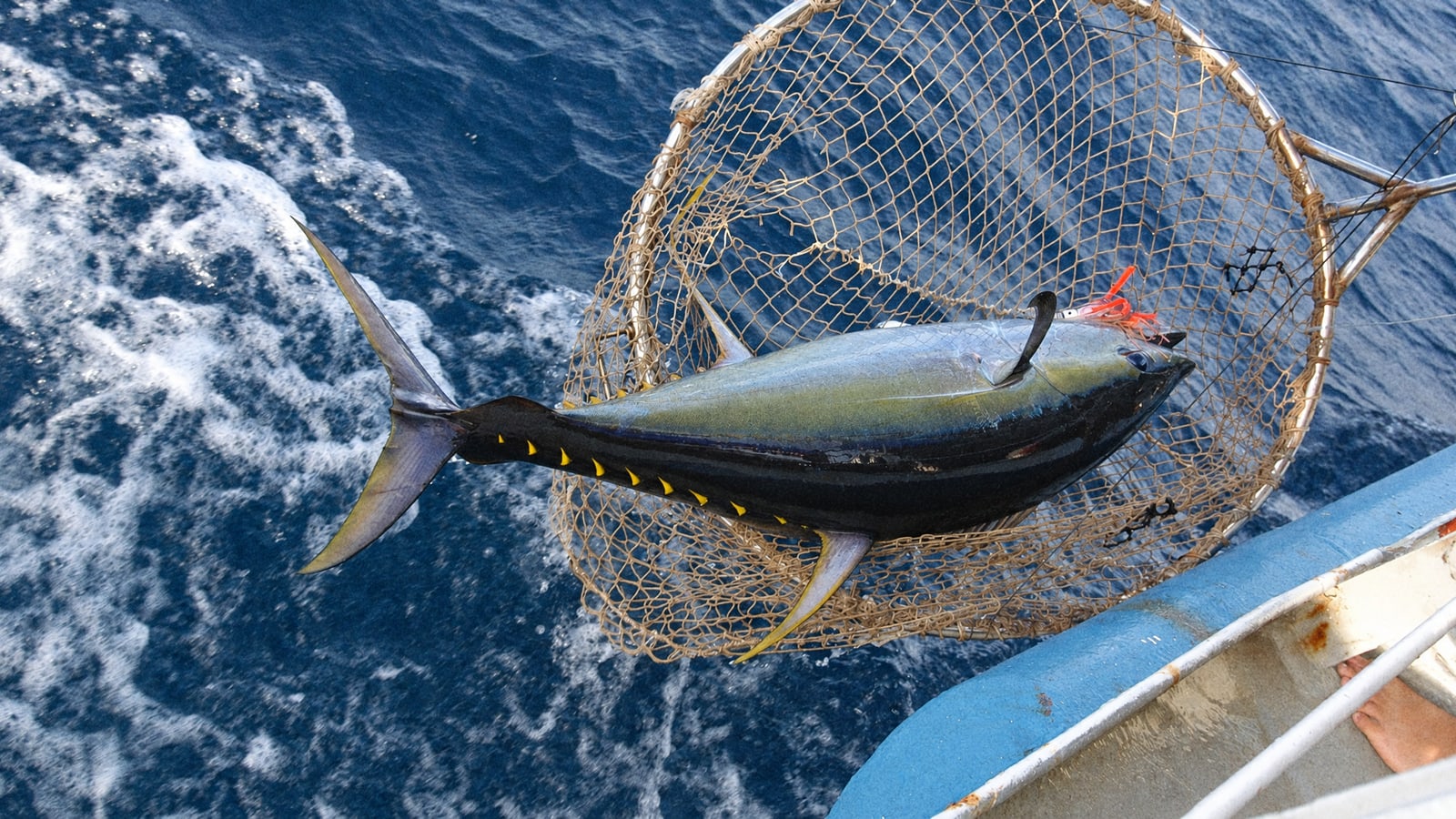
Cover: "Capture d’un thon albacore pour marquage électronique (Ifremer 00699-81068 – 33228)" by Marc Taquet, CC BY 4.0, edited (colour, retouching).
Leave a Reply