
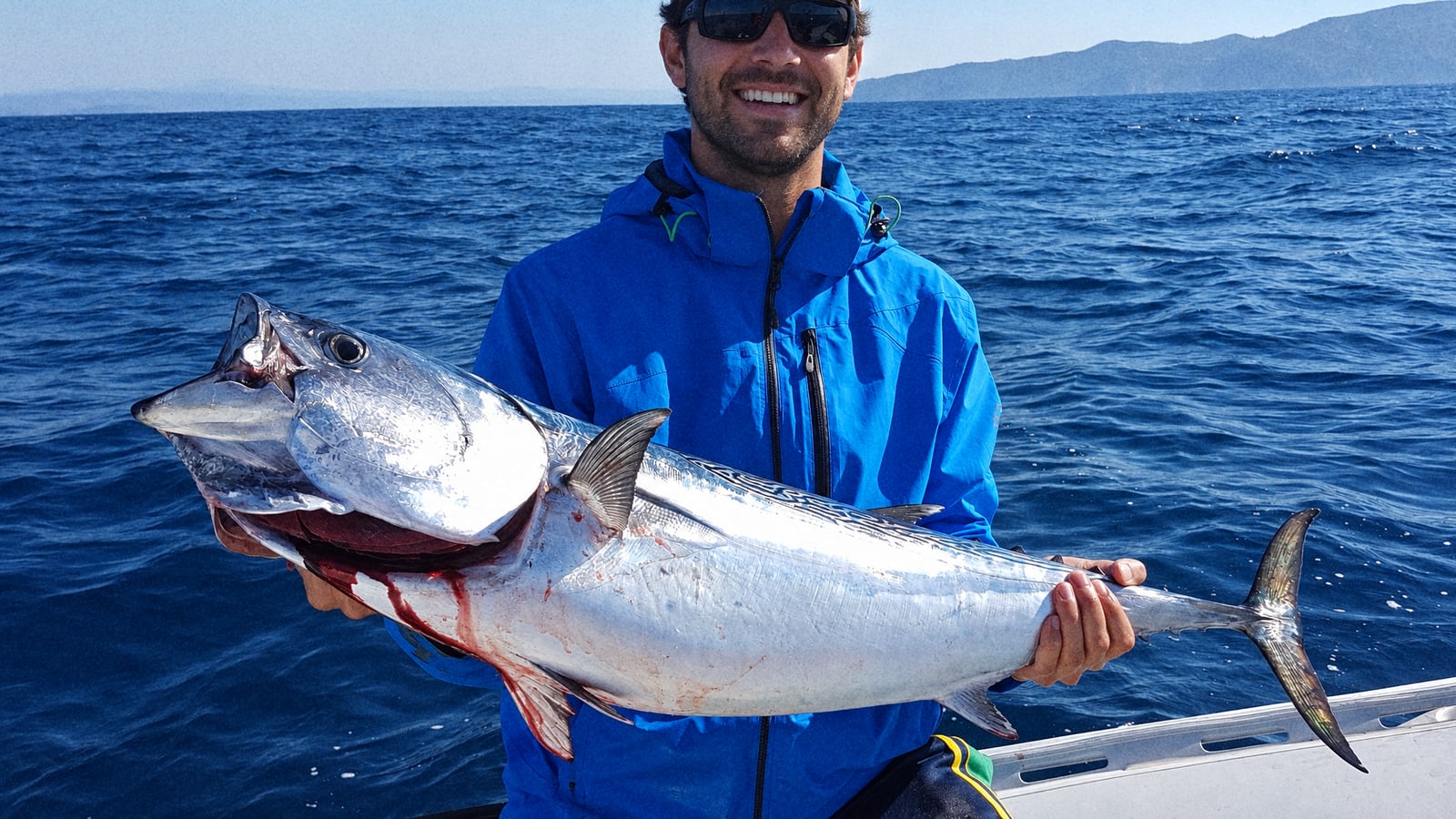
If you are in Gibraltar between late October and February and you want a fish that pulls hard on light gear, the answer is little tunny. The small game boat on the Rock gives that window as its little tunny season, leaves at 06:00 for three or six hours, and brings the rods and lures. These are small members of the tuna family that hunt in fast schools, show themselves by breaking the surface under diving birds, and take a moving lure at speed. A fish of a few kilos on a spinning rod will run more than once, which is why anglers who have fought much bigger fish still book this trip.
What follows is what the fish is, why winter is the time for it in the Strait, how a morning after it actually goes, and what to ask before you book.
What a little tunny is, and why people call it false albacore
Little tunny (Euthynnus alletteratus) is a compact, torpedo shaped tuna relative of the Atlantic and the Mediterranean. You know it by the wavy dark lines on the back above the lateral line and, on most fish, a few dark spots below the pectoral fin. In the United States it goes by false albacore or “albie”, in Spain bacoreta, and you will see all three names on charter pages. It is not a bonito and not a young bluefin, although it shares water with both.
It is also not a tiny fish. The fish sampled in the scientific study below measured from about 30 cm to just over a metre to the fork of the tail. On a light spinning rod even an average one takes line off the reel in long runs and then circles under the boat, so the fight lasts far longer than its size suggests.
Why late October to February in the Strait
The best published work on little tunny in our part of the world is a 2018 study for ICCAT, the Atlantic tuna commission, by Saber and colleagues. They measured and examined 1,266 little tunny caught between 2003 and 2017 along the Spanish Mediterranean coast and the Atlantic south of Iberia, with Tarifa and Ceuta on the Strait and Malaga and Fuengirola on the Alboran Sea among the sampling ports. About a quarter of the fish in their sample came from recreational trolling, so these are the same fish a charter boat finds.
Two findings matter to a visitor. The fish spawn from June to August, with the peak in July, and their spawning condition drops away sharply from September to December. And females reach maturity at around 50 cm to the fork, males a little smaller, at roughly two years old.
Put that next to the boat’s own calendar and it makes sense. By late October the spawning is over and the fish are feeding hard on small baitfish to rebuild condition, and that is when Blue Horizon says the little tunny turn up in the Strait. It is also when the bluefin story ends: the summer tuna trips work two windows, mid June to mid July and mid August to mid October, and the winter belongs to the smaller, faster fish. Our Gibraltar fishing calendar by season sets out the whole year month by month.
The trip to book for them
Reelzy has two boats in Gibraltar, both run by the same operator, Blue Horizon, and both working from the Queensway area on the west side of the Rock. Only one of them is a little tunny trip.
The Blue Horizon Small Game trip is the one. It runs 3 hours or 6 hours, both departing at 06:00, for up to four guests on a private boat. Its listing names little tunny from late October to February, mackerel all year round, and harder targets on the bottom: red snapper, dentex, grouper and amberjack, plus octopus, squid and cuttlefish. Rods, reels, lures and nets are supplied, and so are fuel, snacks, water and soft drinks. The techniques it lists include spinning, trolling, jigging and popping on top of bottom and drift fishing, which is the full toolkit for a fish that can be anywhere from the surface to the seabed.
The other boat, Blue Horizon Tuna Fishing, is a dedicated bluefin trip. Outside its summer dates it is the wrong booking for a winter visitor.
Three hours or six? Three hours suits a first try, a family, or a morning before a flight. Little tunny move in schools and the boat has to find them, so six hours buys more time on the water when the birds are working, and a switch to the bottom for snapper or dentex if the surface goes quiet.
How a morning after little tunny goes
The boat leaves in the dark at 06:00 and heads out into the Bay or the Strait while the light comes up. The first job is finding fish, and the signs are the same anywhere little tunny feed: gulls and terns diving on one patch of water, small fish spraying out of the surface, and then the splashes of the tunny themselves crashing through the bait.
There are two ways the crew will usually go at them. One is trolling small lures behind the boat at speed, which covers water while the fish are scattered and is the easier method for a beginner, because the boat does most of the work. The other is to run up to a feeding school, cut the engine and cast a metal lure or a small jig into the splashes, then wind it back fast. That second way is the one people remember. The take is a hard jolt, the reel screams, and you hold on.
Then comes the part that surprises people. A little tunny rarely gives up after the first run. It comes back towards the boat, sees it, and goes again, then circles deep under the hull. Keep the rod up, let the drag do its job and do not try to winch it in. The crew will tell you when to lift and will net or lip the fish for you.
If the schools are not showing, the boat has other options. Mackerel come in any month and are easy fish for children or anyone who has not fished before, and the bottom marks hold the snapper, dentex and amberjack the listing names. A winter morning in the Strait is rarely empty, even when the tunny are elsewhere.
Keeping one, or letting it go
The Small Game listing says the guests keep their catch, and it also welcomes catch and release. The skipper notes there are no quota limits on little tunny, unlike bluefin, but Gibraltar’s general fishing rules still apply on board, so ask the crew what is legal to keep on the day.
Little tunny are dark, strong flavoured fish. If you want to eat one, keep one or two and ask for them to be bled straight away and put on ice; the boat has an ice box. Treated that way the meat is good raw or seared, and badly handled it is not worth eating. Many anglers release most of what they catch. Release is quick if the fish is unhooked in the water or lifted with wet hands and put back headfirst, and the smaller fish under about 50 cm are the young ones that have not yet spawned.
Permits, clothes and the questions to send first
Gibraltar’s Marine Protection Regulations give a rod and line permit to its holder alone, and a visitor fishing from a boat applies for a temporary Class B2 permit. The Small Game listing ticks Fishing License among what is included, so ask the skipper whether that covers each guest or whether you need your own. Our guide to whether you need a fishing permit on a Gibraltar boat trip goes through the regulations. Children under 14 need no permit.
Winter mornings on the water are colder than the town suggests. Bring a windproof layer, a warm hat for the 06:00 start, sunglasses for spotting birds and splashes once the sun is up, and shoes with grip. A strong Levante can stop small boats going out. If the captain cancels for unsafe weather you get a full refund or a free new date under our cancellation policies.
Before you book, send these in the chat on the listing. Have the little tunny arrived yet this season, and how have the last few trips gone? Is the 3 hour trip enough time to find them, or should we take 6? Do you fish them mostly by trolling or by casting at the schools? Does the included licence cover each of us? Where exactly do we meet at 06:00?
If you want to see both boats and their dates side by side, they are on one page: fishing charters in Gibraltar. And if this is your first time on a boat on the Rock, our guide to what to expect on a Gibraltar fishing trip walks through the morning from the pontoon to the return.
Leave a Reply