
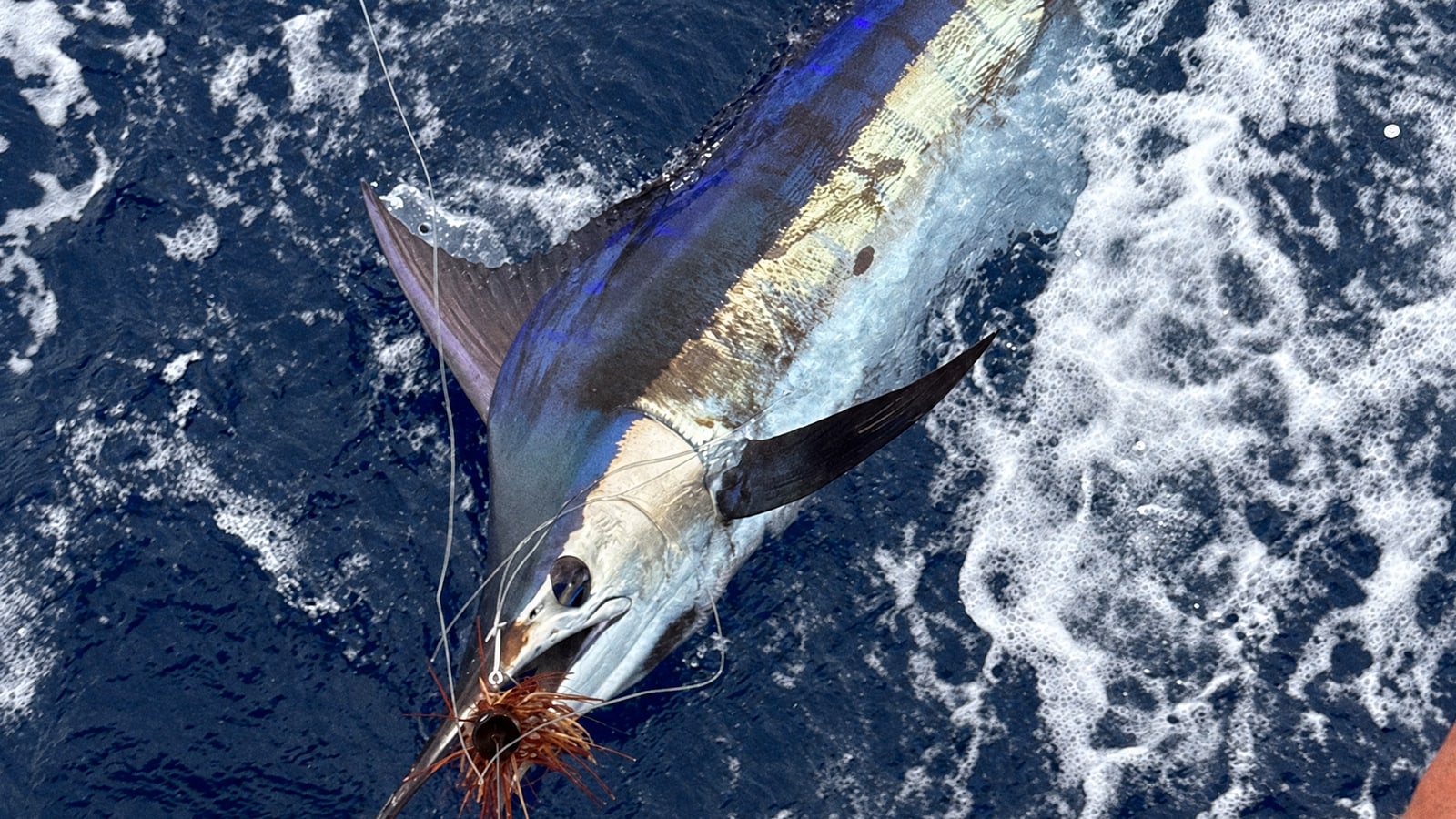
Yes, you can release a marlin in Mauritius, but it is something you settle with the skipper before the boat leaves the jetty, not when the fish is already at the side. There is no national rule that every marlin caught on a sport boat must go back, and on many boats a fish that is brought in stays with the boat. If you want yours released, say so when you book, ask how the boat rigs its baits and lures, and agree on how the photo gets taken. A crew that knows in advance can rig and plan for it. A crew that finds out with the fish at the side has already made its choices.
That matters more than it used to. In its 2025 assessment the Indian Ocean Tuna Commission found Indian Ocean blue marlin both overfished and subject to overfishing (IOTC stock status summary), and the IGFA told the commission in 2026 that striped marlin are in the same state. A released fish from a charter boat will not fix a commercial stock problem, but it is the one thing an angler on holiday decides.
Who decides what happens to the fish
On a Mauritius charter the catch belongs to the boat by default. Fish are shared with guests in an informal way, wahoo and dorado for dinner, reef fish for a family, and part of the rest is sold. We go through the whole custom in who keeps the fish on a Mauritius charter, and the short version for billfish is that some boats release them as a matter of course and others keep them.
You can see how a boat thinks about this in its own listing. Pyramide, the 26 foot boat of Skipper Mike Seblin and his brother Hansley out of Trou-aux-Biches, names marlin and spearfish among its targets and says that you and the crew each keep one fish under 10 kilograms. A marlin is far over that, so the arrangement simply does not cover it, which is exactly the gap to close in the chat before you go. Fishing on Ivan, a 36 foot boat from the same village with a fighting chair, says you share the catch with the crew after the trip. Neither listing mentions billfish release, and that is normal: almost nobody writes it down. Ask.
What a proper release looks like
The clearest written standard in Mauritius comes from the La Pirogue Marlin World Cup, the tournament fished out of the west coast with the Le Morne Anglers Club as its weigh station and IGFA rules on top. Its rules (the 2024 edition is public) are written for competitors, not for tourists on a half day, but they describe what a careful release is:
- any blue, black or striped marlin estimated at 400 lb (about 180 kilograms) or less has to be released, and every sailfish, spearfish and shark goes back;
- natural baits, live or dead, are fished on non-offset circle hooks only, because a circle hook tends to catch the corner of the jaw instead of the throat;
- a release counts when a crew member has the leader in hand with the fish identifiable alongside, and then the hook is removed or the leader is cut as close to the hook as possible;
- a fish that throws the hook after the leader has been let go is not a release, and the whole thing is filmed to prove it.
None of that is law for a charter guest. It is still a good checklist. If a skipper fishes lures behind the boat, the circle hook question becomes a question about how quickly the crew can get the hook out or cut the leader. If the boat fishes live bait near the FADs, ask what hooks they put on.
How to ask, in plain words
Send it through the booking chat a few days ahead, so the answer is in writing. Something like: we would like to release any marlin, sailfish or spearfish we catch; do you fish circle hooks on baits; can we take a photo with the fish in the water at the side of the boat. A crew that releases fish regularly will answer in one line. A vague answer tells you something too.
Talk about the photo early. The classic picture of a marlin hanging from the gin pole on the jetty is the photo of a dead fish. A billfish this size should stay in the water: the crew holds the leader and the bill, the fish lies alongside, someone on the flybridge or at the rail shoots it, and the boat idles forward slowly so water runs over the gills until the fish swims off by itself. Hand your phone to the mate before the fight starts. Nobody wants to look for it while a marlin is at the side.
Ask, too, how long they are prepared to fight a fish. A shorter fight on heavier tackle leaves a fish in far better shape than an hour on light line. On a big game boat such as Last Cast in Grand Baie, which fishes the marlin grounds and the FADs off the north with two to four guests, or Big Game Fishing out of Rivière Noire, which goes out with two skippers and names blue and black marlin and sailfish, the crew will normally bring a fish in quickly anyway. Telling them it is going back means nobody needs to tire it out for the gaff.
Tagging: what to expect in Mauritius
Here is where the word in a lot of searches meets reality. Tag and release, with a small plastic dart tag placed in the shoulder of the fish and a card sent to a research programme, is common in Australia and the US. As of October 2026 we could not find a public tagging programme for Mauritius sport boats, and none of the Mauritius boats on Reelzy mentions tags in its listing. Scientists have put satellite tags on billfish in Indian Ocean waters through IGFA projects, but that is research work, not something a guest can sign up for on the day.
So if tagging matters to you, ask the skipper directly whether the boat carries tags and for which programme. If the answer is no, a clean release with a photo in the water is the same result for the fish.
The season and the boats that fish for it
Marlin are realistic from roughly October or November into April, with the best of it in the summer months, and we cover what the start of the season looks like in fishing in Mauritius in November. Blue marlin are the fish Mauritius is known for, black marlin turn up too, and both have their own pages with the boats that target them: blue marlin charters in Mauritius and black marlin charters in Mauritius.
Most of the boats that run full big game days leave from the north west. Trou-aux-Biches has the most of them, a short run from the drop-off, and that is where a release request is least likely to surprise anyone. Book a full day if marlin are the point: a half day leaves very little time on the grounds, and a crew in a hurry to get back is less patient with a fish at the side.
A short checklist for the chat
Before the day, you want four answers: whether the boat releases billfish if you ask, what hooks it uses on baits, whether you can photograph the fish in the water, and whether it carries tags. Ask them in the booking chat on the listing, keep the reply, and remind the mate on the morning. Then fish.
Cover: "Makaira nigricans Pacific" by quokka2, CC BY 4.0, edited (colour, retouching).
Leave a Reply